


One of the biggest challenges in impact investing is measuring outcomes that truly reflect changes in people’s lives.
How can impact investors better understand the difference their investments make in people's lives? Accial Capital shares five lessons from testing AI-enabled surveys to gather feedback directly from borrowers.
About this projectStrengthening impact measurement through digital surveys |
One of the biggest challenges in impact investing is measuring outcomes that truly reflect changes in people's lives. Over the past two years, we have refocused our impact approach around one central question: How is access to credit affecting our clients' financial lives? Like most impact investors, we started by measuring outputs: the number of clients reached, loans disbursed, geographic coverage, and lending volume. We went a step further by recalculating these metrics using standardized methodologies based on granular data to better understand who we finance and at what scale.
But even at this level of detail, we still couldn't answer whether our investments were truly delivering on our impact objectives. That gap is what convinced us we needed a new layer in our impact measurement framework, one built around hearing directly from end clients. The challenge is that collecting this information can be expensive and operationally complex. Traditional survey methods, such as phone interviews by trained researchers, are costly and difficult to scale across an investor’s portfolio on a frequent basis.
This is where digital and AI-powered survey tools offer new opportunities. Over the past two years, we conducted a pilot with several partners to test and refine different approaches, including WhatsApp-based surveys, AI-powered digital avatars and conversational AI phone calls. The pilot was carried out with companies in our portfolio across Asia and Latin America.
The lessons from this pilot offer valuable insights for other impact investors exploring the use of AI-powered tools to strengthen their outcome measurement efforts.
Digital surveys automate key aspects of the survey lifecycle, including programming, translation, and data analysis, making them more efficient and less costly to deploy. They also make it easier to integrate end-client feedback into fast-moving processes like due diligence and ongoing portfolio monitoring. This makes them a useful complement to traditional methods, especially when cost and speed are important considerations.
AI-powered surveys are not equally suited to all client segments. For example, we found that pensioners in Colombia struggled to engage with chatbots, while the same approach worked well, pehaps usuprisingly, for a fintech with a young, tech-savvy client base. The lesson is straightforward: survey methods need to reflect how different client groups use technology and prefer to communicate.
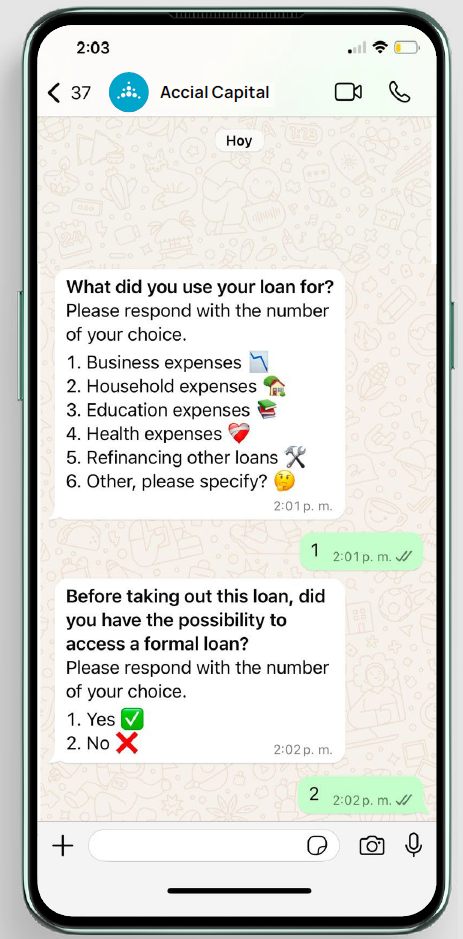
One of the clearest takeaways from the pilot was the importance of active participation by portfolio companies. When surveys were distributed directly by an external firm using an unfamiliar phone number, clients were often suspicious, sometimes even reporting the outreach as spam. This resulted in lower response rates. However, response rates improved when companies helped disseminate the survey through familiar channels or informed their clients in advance. Buy-in from the portfolio company is essential not only for successful outreach, but also for troubleshooting technical issues and adapting the survey approach to what works best for their client base.
Some portfolio companies, especially fintech lenders, already conduct regular customer surveys. Where that infrastructure already exists, it can be simpler to use them rather than bringing in an external provider. Beyond efficiency, this approach also strengthens portfolio companies’ own measurement capacity. It gives them direct visibility into the outcome metrics that impact investors care about and empowers them to continue gathering this feedback to refine their own products.
Despite their advantages, digital surveys typically yield lower response rates than traditional phone surveys. This raises the risk of response bias and limits the reliability of findings in some contexts. As a result, digital methods may be less suitable when highly representative data is needed, for example when assessing an investment where the expected impact is uncertain. They are better suited for monitoring the impact of existing investments, particularly when companies have a large enough client base to support representative sampling.
The findings are helping us challenge our assumptions and refine our impact strategy. As a tech-enabled impact investor, we want to continue exploring how AI, combined with human oversight, can help us better understand the experiences of end clients and the outcomes of our investments.
To learn more about how we are using AI to gain impact insights across our portfolio, read our latest impact report.
We are grateful for the support of our partner FMO, who shares our commitment to understanding and improving impact. We welcome collaboration with others working to advance impact measurement in inclusive finance. If you are exploring similar approaches, we would be happy to connect.
This article was written by Accial Capital and reflects its experience and lessons from the pilot project. FMO is sharing it as part of our work to support stronger impact measurement.