Where pensions stand on nature finance.
The world needs US$571 billion per year in order to meet climate, biodiversity, and land restoration goals. However, current capital flows still overwhelmingly fund activities that degrade ecosystems. With an estimated US$7.3 trillion flowing into nature-negative activities in 2023, compared with US$220 billion into nature-based solutions, the imbalance is 30:1, with nature losing out.
Changing the current trajectory requires leadership from asset owners, yet barriers persist. Gaps in specialist knowledge, unfamiliar revenue models, and a lack of mainstream success stories of natural capital investments are key challenges for investors wanting to deploy capital into nature. However, real and perceived risks are manageable with the right technical expertise, robust environmental metrics, and structures that aggregate projects to scales suitable for institutional investors. Some first mover investors already evidence this, with long-term investments in assets such as sustainable forestry, which is more established and has consistently shown predictable returns. As first movers gain confidence in more traditional nature investments, they begin to explore emerging areas such as payment for ecosystem services and carbon credits. Expanding into these newer opportunities can further diversify and de-risk portfolios, while strengthening overall impact.
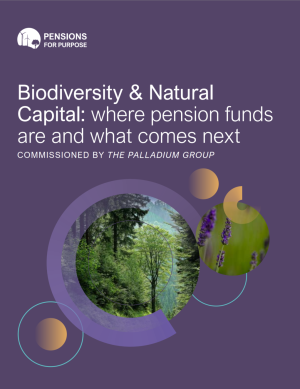
With their capacity and appetite for investing in assets with long-term investment horizons, pension funds have a clear motivation to reallocate capital into nature-positive investments. Funded by the Mobilising Finance for Forests’ Learning, Convening and Influencing Platform (MFF LCIP), Palladium has partnered with Pensions for Purpose (P4P) on a joint workstream focused on unlocking pension fund investments into Biodiversity and Natural Capital. The MFF LCIP, Palladium, and P4P will work together to expand awareness, share evidence, and build asset owners' capacity to invest in nature. This partnership will provide P4P members with practical tools, case studies, and training to help them feel more comfortable committing capital at scale to high-integrity forestry projects, sustainable agriculture, and other types of natural capital investments.
As the partnership’s first output, MFF LCIP commissioned a knowledge product on pension funds’ current levels of allocation to nature, and their motivations, risk management approaches, and barriers to further investment. Based on 20 interviews with asset owners, asset managers, and specialist investment consultants, the paper provides a granular overview of how selected pensions have allocated funds to natural capital over the last few years and offers practical strategies for supporting other pension funds in launching or levelling up their natural capital investment strategies.
The initial results of the study reveal a growing interest in nature and biodiversity-focused investing across the pensions sector. Out of the 20 interviewed, 13 had already allocated funds to natural capital. The main reasons cited for doing so included portfolio diversification and inflation protection, with net-zero commitments reinforcing the rationale rather than representing the primary motivation. Common entry points for investment in natural capital included sustainable forestry and sustainable agriculture, given their established track records and long-term investment horizons that align well with pension liabilities. Many interviewees also noted that allocations tended to focus on developed rather than emerging markets. Developed markets bring stability and familiarity; however, given the higher returns and greater impact potential, early adopter pension funds are beginning to expand into emerging markets.
Despite positive signals, interviewees flagged that many real challenges remain for pension funds looking to invest in nature, including limited exit options, illiquidity, and limited track records. Early adopters, however, are finding solutions to these challenges, including portfolio diversification and developing robust track records via partnerships with experienced portfolio managers and multilateral institutions. Interviewees who have already allocated capital to nature explained that partnering with specialist managers or DFIs can support due diligence and pipeline development, while using robust environmental metrics to ensure integrity in investment decisions.
Overall, P4P’s trusted relationships with asset owners, managers, and advisors, combined with Palladium and MFF’s technical depth in climate, natural capital, and blended finance, will help to reduce uncertainty and translate pension funds’ growing interest in natural capital into investment action. To read more detailed outcomes of the study,click here. To find out more about P4P and Palladium’s motivations for this partnership, listen to this podcast on why mobilising the pensions sector matters and how to move from interest to allocation.
This partnership is funded by the Mobilising Finance for Forests’ (MFF) Learning, Convening and Influencing Platform (LCIP), a blended finance program delivered by FMO and funded by the UK government and the government of the Kingdom of the Netherlands. MFF was established in 2021 to combat deforestation and other environmentally unsustainable land-use practices that contribute to global climate change.

The MFF Program is delivered by FMO and funded by the government of the United Kingdom and the government of the Netherlands.