

Against the backdrop of an unprecedented heatwave across Europe, making the climate and nature crises impossible to ignore, London Climate Action Week (LCAW) 2026 highlighted the partnerships, financial commitments, and innovations needed to drive meaningful change.
Last week, the UK capital hosted approximately 75,000 people across more than 1,000 events – one of the largest Climate Weeks yet. This is a strong reminder that the climate crisis continues to be an urgent issue for businesses, investors, government, and communities alike. However, the message last week was clear: investor appetite for climate-related investments is growing, but hesitation remains a barrier to action at the scale and urgency needed. Factors such as uncertainty around incoming policies and regulations, continued concerns around risk and returns, and a shortage of scalable projects are preventing capital from being mobilized quickly enough to keep pace with climate change.
Yet, following discussions across the week on clean energy, infrastructure, the climate transition, and nature and biodiversity, there was a strong sense that many of the solutions already exist. The key challenge now is bringing together the partnerships, policy frameworks, and investment needed to deliver them.
Recent analysis of private investment in nature released during London Climate Action Week suggests that capital is increasingly flowing towards sustainable and nature-positive opportunities. The Nature Conservancy and Forest Trends’ Gaining Ground: State of Private Investment in Nature 2026 report found that more than $60 billion was invested in nature-focused activities between 2016 and 2025, with annual investment volumes increasing fivefold. In addition, a further $180 billion is targeted for deployment in the coming years. The report also highlights that the market view of sustainable investments is changing. There is a growing belief among investors that environmental outcomes and financial performance can be mutually reinforcing, signaling a gradual shift from viewing sustainability primarily as a compliance or reputational issue, towards recognizing it as a source of value creation. In other words: Embedding sustainability within investor portfolios is beginning to be seen as advantageous for both impact and returns.
To support this view, on the first day of LCAW the World Business Council for Sustainable Development (WBCSD) also released the Business Breakthrough Barometer. This revealed that 92% of companies and business leaders expect sustainability to be a competitive advantage over the next 5-10 years, and 52% believe that building resilience and risk management is equally important as regulatory compliance. This also indicates that sustainability is becoming more closely associated with business resilience, competitiveness and long-term growth opportunities, and reflects a broader recognition that resilience is no longer viewed solely as risk mitigation. Instead, it is seen as a strategic capability that can help businesses navigate uncertainty, adapt to changing market conditions, and maintain long-term economic performance.

Mobilizing capital at pace and scale requires reframing risks to investors – particularly when considering nature, sustainable land use, and biodiversity. This year, many discussions at LCAW focused on developing a nuanced understanding of risks in nature investments, as well as identifying the deal structures and partnerships needed to mitigate risks successfully.
Mobilizing capital at pace and scale requires reframing risks to investors
The Mobilising Finance for Forests’ Learning, Convening and Influencing Platform (MFF LCIP), Partnerships for Forests, the UNEP-WCMC and the UNEP Climate Finance Unit co-hosted the session “Financing for forests and sustainable land use: An impactful investment or a risky endeavor?”, which brought together 55 investors, fund managers and project developers to explore practical approaches to managing risk in land-use and nature-based investments. Discussions saw participants sharing practical experience around working with smallholders, investing in higher-risk jurisdictions, navigating limited credit histories, and partnering with Indigenous Peoples and Local Communities. Through this, participants examined the difference between project-level delivery risks or implementation challenges and broader country-level risk perceptions. While delivery risks, regulations and long investment horizons remain important considerations when investing in nature and sustainable land use, many participants agreed that limited track records and investors’ unfamiliarity with the asset class can also present barriers to investment, rather than the underlying viability of the projects themselves.
The event also emphasized the wider benefits that forests and sustainable land use can provide, including biodiversity protection, climate mitigation and adaptation, water security and supply-chain resilience. As resilience becomes an increasingly important consideration for investors and businesses alike, these ecosystem services are emerging as a stronger component of the investment case for nature.
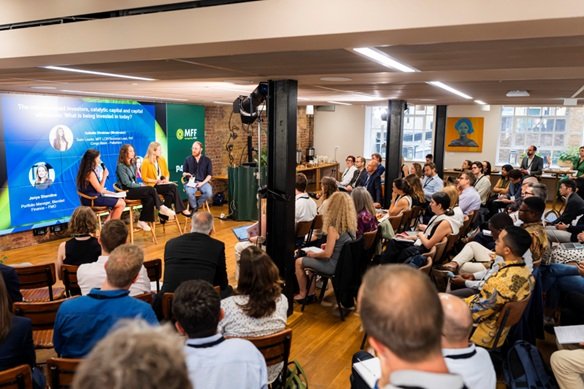
Building and maintaining stakeholder partnerships are an essential mechanism to deliver effective climate action for nature. While land use investments often face complex challenges, many risks can be effectively managed through strong partnerships, local engagement, and fit-for-purpose financial structures.
LCAW presented a key opportunity to unite the stakeholders that play an instrumental role in leading these conversations. Across numerous networking events, small-group roundtables, and Q&A sessions, detailed discussions around risk, impact potential, ESG and financial constraints enabled participants to share experiences, explore different perspectives, and view potential pathways to scaling finance for forests and sustainable land use. MFF LCIP also hosted a LCAW community breakfast for MFF investees, donors, and partner organizations to share key successes and learnings, as well as take advantage of the opportunity to strengthen connections across the MFF network. In addition to this, as Investors’ for Purpose Natural Capital and Biodiversity Partner, MFF LCIP supported their Climate & Nature Ecosystem Forum, which brought together pension funds, specialist fund managers and investment advisors to showcase the scale of the opportunity of investing in the green, nature positive economy. Overall, networks such as these play an important role in connecting investors, fostering collaboration, and building momentum for investment in climate and nature solutions.
Progress will depend not only on more capital, but the speed in which it is deployed
Speeches about ambition and pledges alone will not solve the climate crisis – nature and climate are already affecting decisions surrounding capital allocation, assets, and returns. Investors, project developers, fund managers, and governments must not lose the momentum that LCAW brought, and must follow up on the conversations had last week. The solutions are there – and progress will depend not only on more capital, but the speed in which it is deployed, a stronger collaboration between ecosystem players, and greater confidence in the investment opportunities that support a climate resilient, nature-positive future.

The MFF Program is delivered by FMO and funded by the government of the United Kingdom and the government of the Netherlands.