

The ‘missing middle’ in forests and sustainable land-use investments.
Investment in the forests and sustainable land use sector (FSLU) is gaining traction, and there are growing opportunities to unlock greater private sector participation. However, according to UNEP’s State of Finance for Nature 2026, on a global scale, early-stage forest and restoration-focused private funds total less than €3 billion – which is far below the level required to meet global restoration and biodiversity targets.
The “missing middle” refers to the financing gap faced by nature-positive opportunities, where they may be too advanced for grant or philanthropic support, however, still too high risk, small-scale, or unproven to attract commercial financing. These early- to growth-stage nature-positive projects need catalytic capital to move from pilot phase to the scale needed to absorb commercial capital.
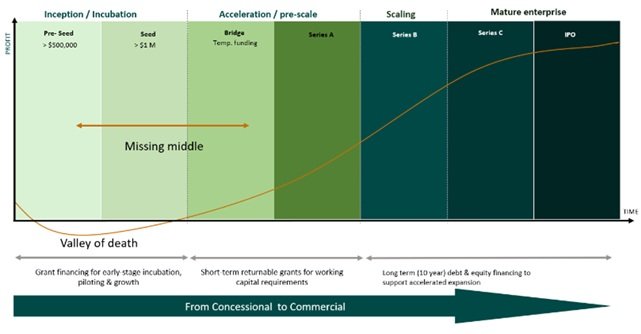
The above graph (source: Regeneration, Palladium) demonstrates that finance is scarce where it is needed most. This lack of financing can be attributed to different facets within earlier-stage natural capital projects. For example, long time horizons, uncertain revenue streams, high upfront development costs, and limited track records. As a result, public and concessional finance tends to dominate the sector, while private investors concentrate on larger, de-risked opportunities with clearer returns. However, to meet the finance flows needed to meet NbS investment needs by 2050 (approximately US$571 billion per year), part of the solution to scaling requires alignment across investors, corporates, governments and intermediaries. Convening these stakeholders together is crucial.
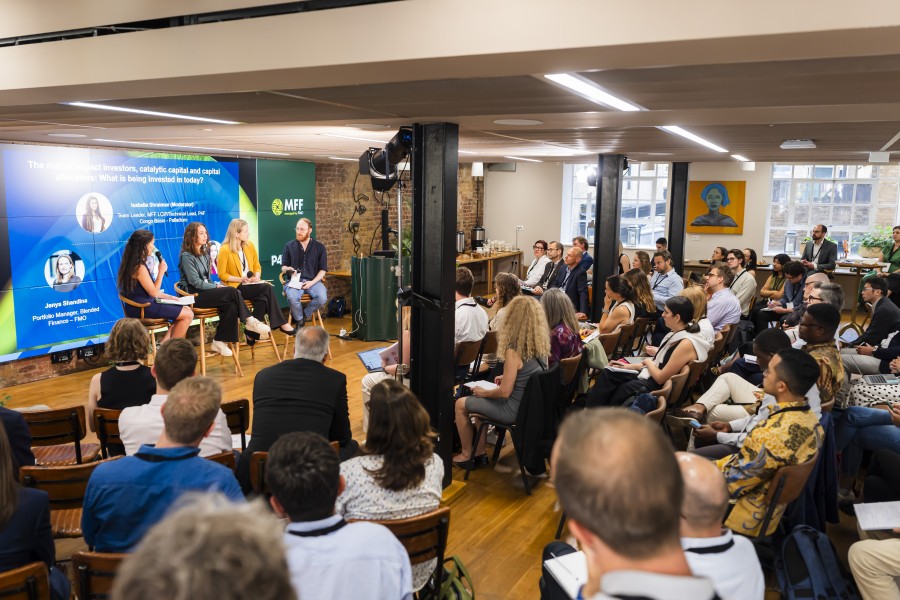
Photo Credits: James Gifford-Mead Photography
On May 28th, the Mobilising Finance for Forests’ Learning, Convening, and Influencing programme, alongside Partnerships for Forests, organized the knowledge exchange "Investing in forests and sustainable land use for growth, resilience and climate: what is working and how can it be scaled?". Held as part of the wider Partnerships for Forests Forum, the day convened 86 participants fund managers, philanthropies, family offices, and project developers to share lessons and insights from market creation efforts and foster partnerships to unlock greater investment, particularly to address the gap in capital from the incubation to early scaling phases.
The morning explored the roles of practitioners across the capital continuum and the importance of market creation and business incubation in unlocking finance, and how to build a stronger pipeline of investment-ready opportunities to increase capital flows. In the afternoon, smaller group exchanges identified practical actions to catalyse investment. This included mock pitching sessions that enabled open dialogue between emerging fund managers and investors, and a discussion on how technical assistance can support ideation, pipeline development, and investment de-risking. Other themes included E&S challenges from incubation to scale; how to unlock local financing for nature and FSLU opportunities; and the potential of pre-competitive financing platforms for bridging this missing middle.
There are many capital and innovative opportunities ready for investment, but accelerating deployment requires bridging the understanding gap between investors and impact-focused funds and projects.
Impact and concessional finance is a key enabler and catalytic element of scaling, particularly in addressing challenges such as fund readiness and capacity constraints. However, there is a persistent misalignment in risk and return expectations among capital providers, who may be unable to shift historical perspectives on what constitutes investment-grade opportunities to drive meaningful impact. For this reason, aligning expectations around risk, return, fund structures, and what investment-grade impact can look like in practice is crucial.
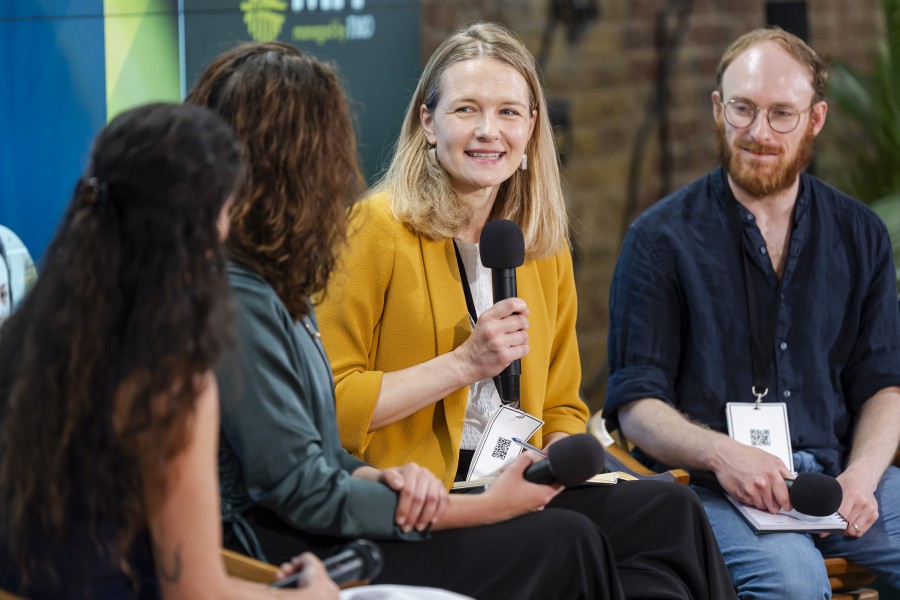
Mobilizing investment requires coordinated collaboration across capital types -impact, blended, and institutional.
The morning sessions focused on the fact that the shortage of “middle-stage” capital cannot be rectified by keeping impact, blended, and institutional capital separate. Public finance already dominates within NbS investment, but is not substitutive of private finance. To help projects become commercially viable and scalable, financial instruments such as blended finance, concessional debt, guarantees, or patient equity is needed to help projects become commercially viable and scalable.

Targeted TA is critical when businesses need to strengthen internal capacity, meet credit and compliance requirements, and unlock access to finance
Discussions around Technical Assistance during throughout the day highlighted that it is the most impactful when embedded across the full project lifecycle rather than focusing on one key stage. Early-stage TA, for example, is essential for strengthening business models and building investment-ready pipelines from the beginning of the project, and post-investment TA is essential to respond to enterprise and larger investor needs.

The MFF Program is delivered by FMO and funded by the government of the United Kingdom and the government of the Netherlands.