
What have we learned about strengthening rural livelihoods through finance?
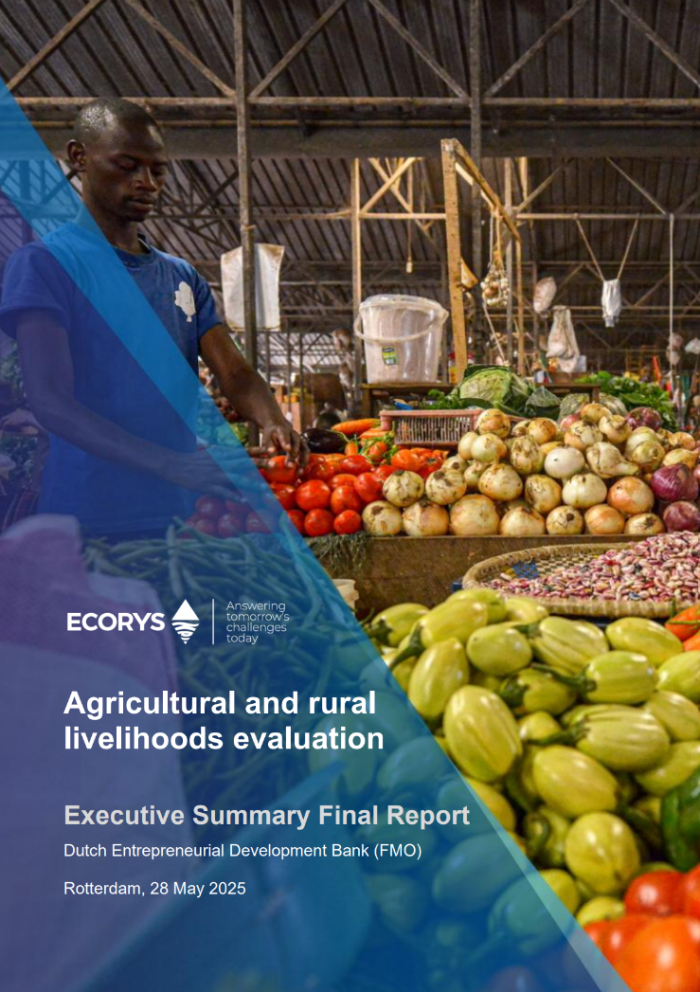
A new independent evaluation of MASSIF’s Agriculture and Rural Livelihoods portfolio, commissioned by FMO and conducted by Ecorys, offers a detailed look at how MASSIF has contributed to strengthening rural livelihoods in low‑ and lower‑middle‑income countries since 2019, and where its impact can be further strengthened.
In 2017, FMO launched the MASSIF Next Frontier Strategy, positioning 'Agriculture and Rural Livelihoods' as one of its four strategic pillars. This priority area focuses on strengthening small businesses in rural areas and supporting agricultural value chains in low and lower middle-income countries.
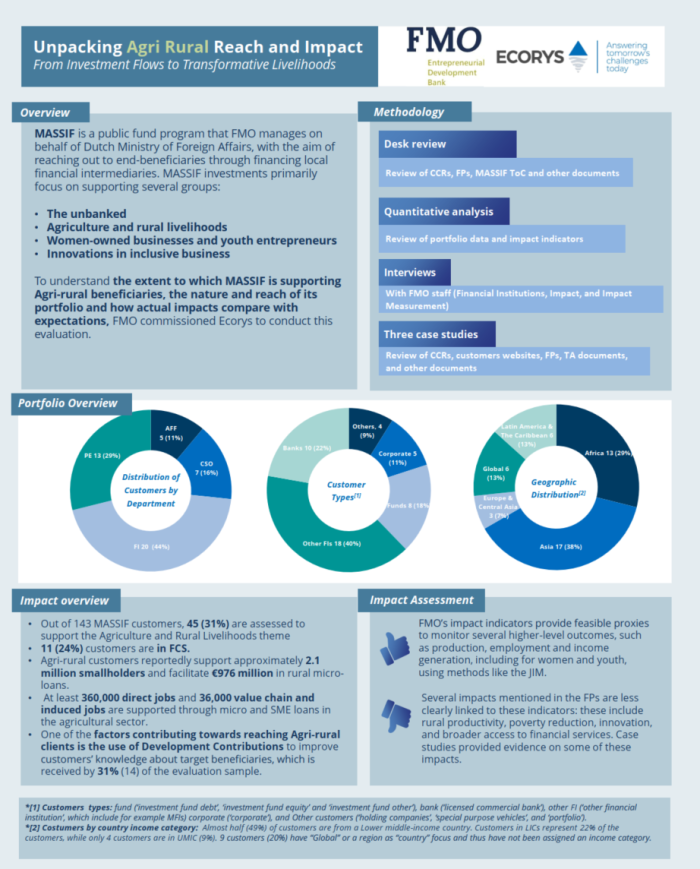
The evaluation was designed with four objectives: to assess the extent of MASSIF’s support for agri rural beneficiaries; to provide insights into the agri rural portfolio; to identify realized impact beyond the indicators FMO currently uses as proxies for this theme; and to evaluate the alignment between expected and actual impact.
Ecorys conducted a comprehensive analysis of this theme within the MASSIF portfolio, applying a mixed methods approach that combined quantitative analysis of FMO’s impact data from active customers between 2018 and 2023 with three in depth case studies.
Out of MASSIF’s 143 active customers, 45 (31%) directly support agriculture and rural livelihoods. Together, these customers have:
Using the Jobs Impact Model (JIM), the evaluation estimates that MASSIF‑backed loans have supported around 360,000 direct jobs and 36,000 value‑chain and induced jobs in agriculture. Most of this activity takes place in low‑income and lower‑middle‑income markets, often characterised by high poverty levels, fragile rural economies, and limited access to finance, precisely where investment gaps are most acute.
The evaluation finds that “Other Financial Institutions” including microfinance institutions and other non‑traditional banking models — play a particularly important role. These institutions account for 76% of rural microloans in the sample.The use of Development Contributions* (DC) has further strengthened customer capacity to reach rural beneficiaries, particularly through:
Together, these elements have helped financial institutions extend services more effectively into rural and agricultural markets.
|
* Development Contributions are non‑commercial support instruments that help reduce risk, build capacity, and catalyse impact where markets are still developing.
|
The evaluation also highlights areas where expectations and outcomes diverged. In several cases, projected microenterprise loan volumes exceeded what customers ultimately delivered, suggesting that some initial projections may have been overly ambitious. While existing impact indicators capture outcomes such as production, employment, and income generation - including for women and youth - broader objectives such as rural productivity, poverty reduction, and innovation proved harder to quantify. Here, the case studies included in the evaluation were particularly valuable, providing concrete, real‑world examples of impact that are not always visible through standard metrics alone.
Based on these findings, the evaluation identifies several opportunities to further strengthen MASSIF’s contribution to agriculture and rural livelihoods:
With these insights, FMO and the Dutch Ministry of Foreign Affairs are well positioned to refine MASSIF’s strategy enabling the fund to further expand its contribution to resilient rural communities, inclusive economic growth, and sustainable agricultural value chains.